Searching for dentures in Everett, Edmonds, or Lynnwood usually starts with one question: which type do you actually need? The three main answers are full dentures, partial dentures, and implant-supported dentures, and each one trades cost, stability, and treatment time differently. Whichever you choose, the design matters as much as the type, because a denture has to fit your gums, line up with your bite, and look natural when you smile and speak.
This is the local version of our denture guides. It compares the three types side by side, gives national price ranges, walks through how a denture case runs at our Lynnwood office, and lists what to ask any provider before you commit.
If your main question is whether you need a partial or a full denture, start with Partial or Full Dentures? How Many Teeth You Still Have Decides It, then come back here for the local details.
Blooming Dental is led by Dr. Sung Wook Yoon, DDS, MS, a prosthodontist, and the practice has two offices, in Lynnwood and Des Moines, Washington. There is no Everett or Edmonds office. Lynnwood is the closer one, and patients from both cities travel to it.
Dentures in Everett, Lynnwood, and Edmonds: Your Three Main Options
The right choice depends on how many teeth you are missing, the health of the teeth you still have, the amount of bone in your jaw, and how much stability you want. Here is the short version.
| Type | Best for | How it stays in place |
|---|---|---|
| Full dentures | No teeth left in an arch, or remaining teeth that cannot be saved | Rests on the gums; held by suction and a close fit |
| Partial dentures | Several missing teeth, with healthy natural teeth still in place | Clasps or precision attachments on your natural teeth |
| Snap-on dentures | A loose denture, especially a lower one, or tired of adhesive | Clicks onto two to four implants; removed at night |
| Fixed full-arch teeth | Teeth that stay in all the time | Permanently attached to four to six implants |
Each arch is assessed separately, so it is common to have a partial on top and a full denture on the bottom, or the other way around.
Full Dentures
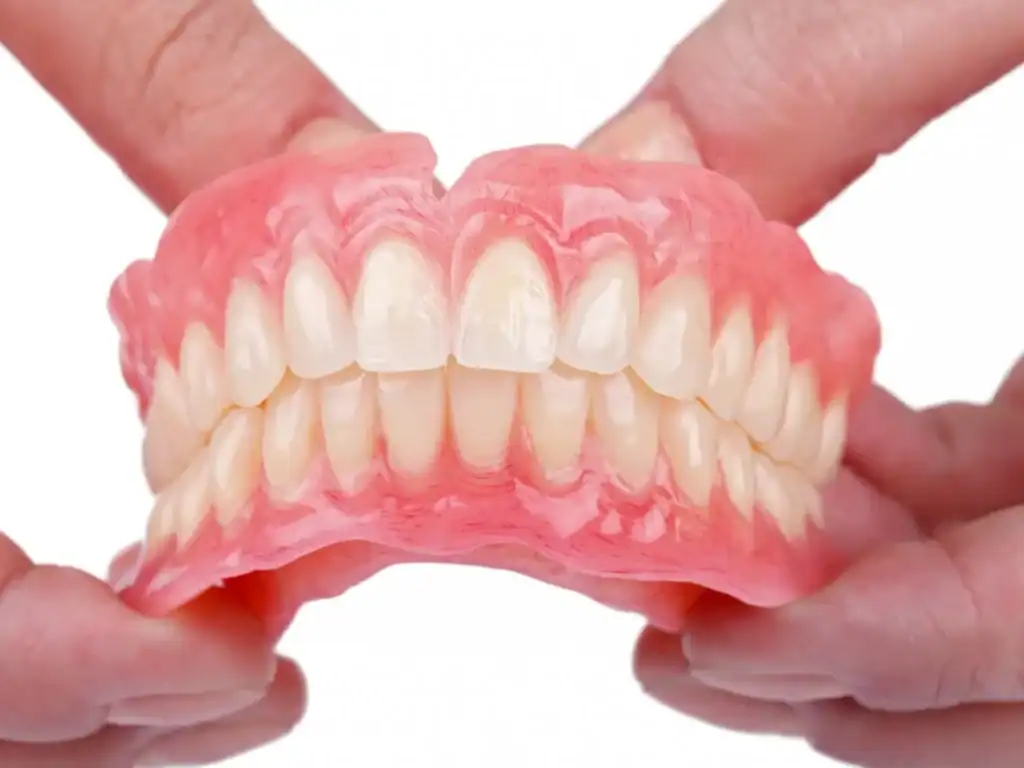
Full dentures replace all of the teeth in your upper jaw, lower jaw, or both. They rest on your gums and are held in place by suction and a close fit. Upper dentures usually hold better than lower ones, because the palate gives an upper denture more surface to grip.
Over time, the jawbone under a denture slowly changes shape, so most full dentures need relining and, eventually, replacement. Our dentures page says traditional dentures typically last 5 to 7 years for that reason.

Partial Dentures
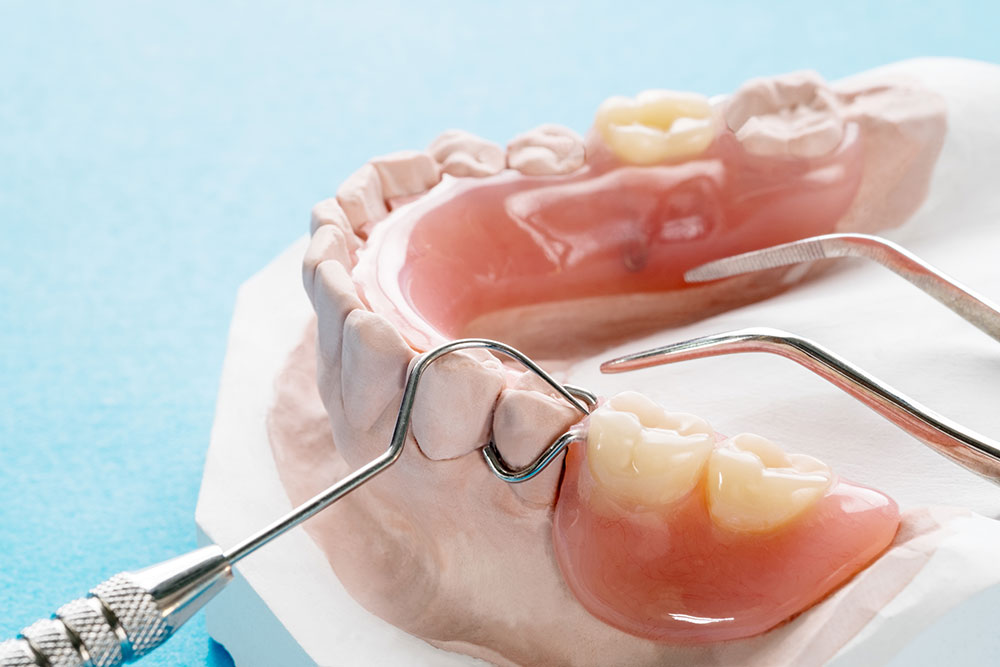
Partial dentures replace several missing teeth while keeping your healthy natural teeth in place. They attach to your remaining teeth with clasps or precision attachments, so your own teeth help hold them. A well-balanced design spreads chewing force evenly and avoids the rocking and sore spots of a poorly fitting partial. The trade-off is that the teeth supporting the partial need to stay healthy, with good brushing and regular checkups.
Implant-Supported Dentures
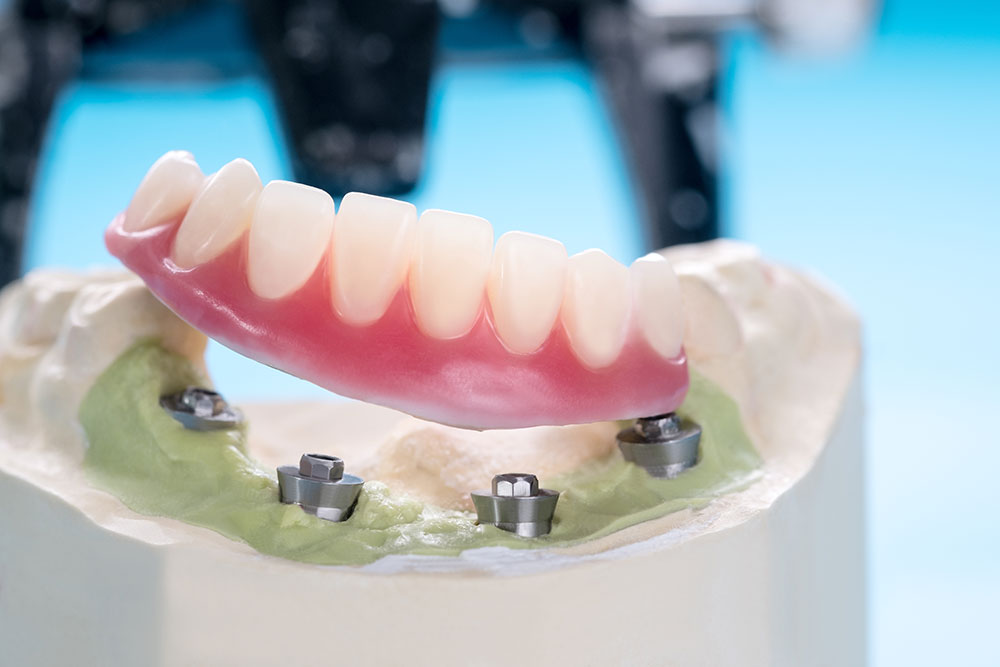
Implant-supported dentures use dental implants, small titanium posts placed in your jawbone, to anchor the denture. There are two main styles:
- Snap-on dentures (implant-retained overdentures) click onto two to four implants. They stay put when you eat and talk, do not need adhesive, and come out at night for cleaning. See our snap-on dentures page for how they work.
- Fixed full-arch teeth, such as All-on-4 or All-on-6, attach to four to six implants and do not come out. Only your dentist removes them. Compare them on our full mouth dental implants page or in our guide to which full mouth option fits your bone, bite, and budget.
When Do Implant-Supported Dentures Make Sense?
The clearest case is a lower denture that will not stay put. Lower dentures are the least stable, because tongue and jaw movement keep unseating them, and our snap-on page says just two implants can turn a floating lower denture into a stable one. Implants also act like tooth roots, anchoring the denture and helping slow the bone loss that makes regular dentures loosen.
What you give up is time and simplicity. Implant placement is surgery, and implant-retained dentures typically take 3 to 6 months because the implants need time to fuse with the bone. A 3D scan at your consultation shows whether your bone can support them. Health factors such as gum disease, smoking, or diabetes do not automatically rule implants out, but they shape the plan.
Many people start with a conventional denture and add implants later. If that is your plan, say so at your first visit, because the first denture has to be designed with that in mind. If your current denture fits well and is in good condition, it can sometimes be converted to snap-on.
Blooming Dental plans the implant position from a 3D scan against the denture or crown that will sit on it. You can read more about implants at our Lynnwood office.
What Do Dentures Cost? National Price Ranges
Dentures are priced by type, and the gap between types is large. These national reference points come from two sources, and they are not a quote for your mouth.
| Type | National reference | Source |
|---|---|---|
| Full traditional denture | About $2,022 on average (range $1,493 to $3,309) | CareCredit 2026 study |
| Partial denture | About $1,780 to $2,293 on average, depending on material | CareCredit 2026 study |
| Snap-on denture | About $6,000 to $15,000 per arch | Our snap-on dentures page |
| Fixed full arch | About $15,000 to $30,000+ per arch | Our snap-on dentures page |
The ranges are not like for like. The snap-on and fixed ranges cover the implants as well as the teeth, while the traditional denture figures do not. Your own price depends on the number of implants, whether you need a new overdenture or can convert your current one, and any extractions your case needs. For implant pricing in more detail, see our guide to dental implant costs in Washington State.
Blooming Dental accepts Delta Dental and UHC, files claims with other carriers as an out-of-network provider, and checks your benefits before treatment at no charge. Out-of-network plans typically reimburse 50 to 80 percent of covered procedures. Financing is available through CareCredit, Cherry, Lending Club, and HFD, and HSA and FSA funds are accepted. Details are on our financing and insurance page.
How Long Does the Denture Process Take?
Traditional dentures typically take 4 to 6 weeks, including impressions, try-ins, and delivery. Implant-retained dentures typically take 3 to 6 months, because the implants need time to fuse with the bone first. Your consultation gives you a realistic timeline for your case. Every denture case follows the same careful sequence, with try-ins before anything is final:
- Consultation and exam. Dr. Yoon examines your mouth, takes the 3D imaging your case needs, and talks through your goals, bone condition, and budget.
- Digital impressions. Digital scans replace traditional impression trays.
- Custom design. Your denture is designed around your face, your bite, and your preferences for tooth shape and color.
- Try-ins. You try the denture before it is finished, so fit, appearance, and bite can be adjusted while changes are still easy.
- Final fitting and adjustments. You receive your denture, and we make the small adjustments that are normal as your mouth adapts.
If teeth need to be removed first, ask how the healing period will be handled, since that affects both the timeline and what you wear in the meantime. Our partial vs full guide explains the difference between an immediate denture and a final one.
Living With New Dentures: The First Few Weeks
New dentures take some getting used to. The American Dental Association’s MouthHealthy site notes that they may feel awkward for a few weeks, may feel loose while your cheek and tongue muscles adapt, and can bring minor soreness and extra saliva at first. These habits help:
- Start with soft foods cut into small pieces, and chew evenly on both sides of your mouth.
- Practice speaking. Reading aloud helps your tongue and lips adjust.
- Call for an adjustment if a spot stays sore rather than putting up with it.
- Clean them daily with a soft brush and a nonabrasive denture cleanser. The ADA’s denture care page also says to avoid bleach and powdered household cleansers, and to keep dentures in water or denture cleanser, never hot water, when they are out of your mouth.
- Ask about overnight wear. Snap-on dentures are designed to come out at night for cleaning, and your dentist can tell you what is right for a traditional denture.
- Keep up with checkups. Your mouth changes over time, and the ADA lists a denture more than five years old among the red flags that it may need relining or replacing.
What to Ask Before Choosing Dentures in Everett or Edmonds
Whether you are comparing Everett dentures providers, clinics near Edmonds, or our Lynnwood office, the same questions separate a well-planned denture from a rushed one.
- Who designs the denture? Prosthodontics is one of the 12 dental specialties recognized by the American Dental Association, and it takes three years of full-time training after dental school, spent on restoring and replacing teeth. Ask who will plan your case and what their training is.
- Will I try the denture in before it is final? A try-in lets you judge the fit, look, and bite while changes are still easy.
- Who plans the implants if I want them? Ask whether the same clinician plans the implants and the denture together, so the implants go where the finished teeth need them.
- What will it cost, in writing? Ask for a written estimate that includes extractions, implants, and follow-up visits, and ask what your insurance will pay.
- Which days can I be seen? Adjustments are normal in the first weeks, so check how often the office is open. Our Lynnwood office runs one clinic day a week, and the same team sees patients in Des Moines on three other days.
- What is the plan for relines and replacement? Ask how often the fit will be checked and when a replacement is likely.
Visiting Our Lynnwood Office From Everett and Edmonds
If you are looking for dentures in Lynnwood, or traveling from Everett or Edmonds, our office is at 4215 198th Street SW, Suite 205, a short drive from Alderwood Mall and easy to reach from both I-5 and Highway 99. Patients come from Everett on I-5, from Edmonds along 196th Street SW, and from Mountlake Terrace on 44th Avenue W or I-5.
It is an adult office, so appointments run longer and the day is built around treatment rather than volume. The practice is accepting new adult patients at Lynnwood.
The Lynnwood office runs one focused clinic day each week, Wednesdays from 9:00 am to 4:00 pm. If you need to be seen on another day, the same team treats patients at our Des Moines office on Mondays, Tuesdays, and Thursdays, about 30 miles south. Your first visit is a consultation with a prosthodontist: a full examination, the 3D imaging your case needs, a written treatment plan, and a written estimate before any treatment is scheduled.
To book at Lynnwood, call (425) 775-1800, or reach Des Moines at (253) 838-4363. You can read more on our Lynnwood office page and Des Moines office page, and the dentures page lists every option we offer at both offices.
Frequently Asked Questions
Does Blooming Dental have an office in Everett or Edmonds?
No. Blooming Dental has two offices, in Lynnwood and Des Moines, Washington. Lynnwood is the closer one for patients in Everett, Edmonds, and Mountlake Terrace. It is near Alderwood Mall, reachable from I-5 and Highway 99, and open on Wednesdays from 9:00 am to 4:00 pm.
How long does it take to get dentures?
Traditional dentures typically take 4 to 6 weeks, including impressions, try-ins, and delivery. Implant-retained dentures typically take 3 to 6 months because the implants need time to fuse with the bone first. Extractions or bone grafting can add time, and you get a realistic timeline at your consultation.
How much do dentures cost?
As national reference points, a 2026 CareCredit study put full traditional removable dentures at about $2,022 on average, with a range of $1,493 to $3,309, and partial dentures at about $1,780 to $2,293 on average depending on the material. Snap-on dentures on two to four implants run about $6,000 to $15,000 per arch nationally, according to our snap-on dentures page. These are references, not quotes. You receive a written estimate before any treatment is scheduled.
Does insurance cover dentures?
Often partly. The 2026 CareCredit study says private dental plans typically cover about 50% of partial or full dentures, depending on the plan. Blooming Dental accepts Delta Dental and UHC, files claims with other carriers as an out-of-network provider, and checks your benefits before treatment at no charge. Original Medicare does not cover dentures.
Can my current denture be converted to a snap-on denture?
Sometimes. If your current denture fits well and is in good condition, snap housings can often be added to it after the implants are placed. Bring it to your consultation, and the team will tell you whether it can be converted.
How many implants does a snap-on denture need?
Usually two for a lower denture and four for an upper. More implants add stability, and on an upper arch four implants can allow a slimmer design without the palate covering. A 3D scan at your consultation shows what your bone supports.
How long do dentures last?
Traditional dentures typically last 5 to 7 years before replacement, because the shape of your jaw changes. With snap-on dentures, the implants can last for decades, while the denture itself typically serves 5 to 10 years before it needs relining or replacement. Regular checkups help catch fit problems early.
Can I be seen on a day other than Wednesday?
Yes. The same team treats patients at our Des Moines office on Mondays, Tuesdays, and Thursdays. Des Moines is about 30 miles south of Lynnwood. Call (253) 838-4363 for Des Moines or (425) 775-1800 for Lynnwood.

Schedule a consultation and leave with a clear, personalized plan — including what insurance covers and what financing looks like.