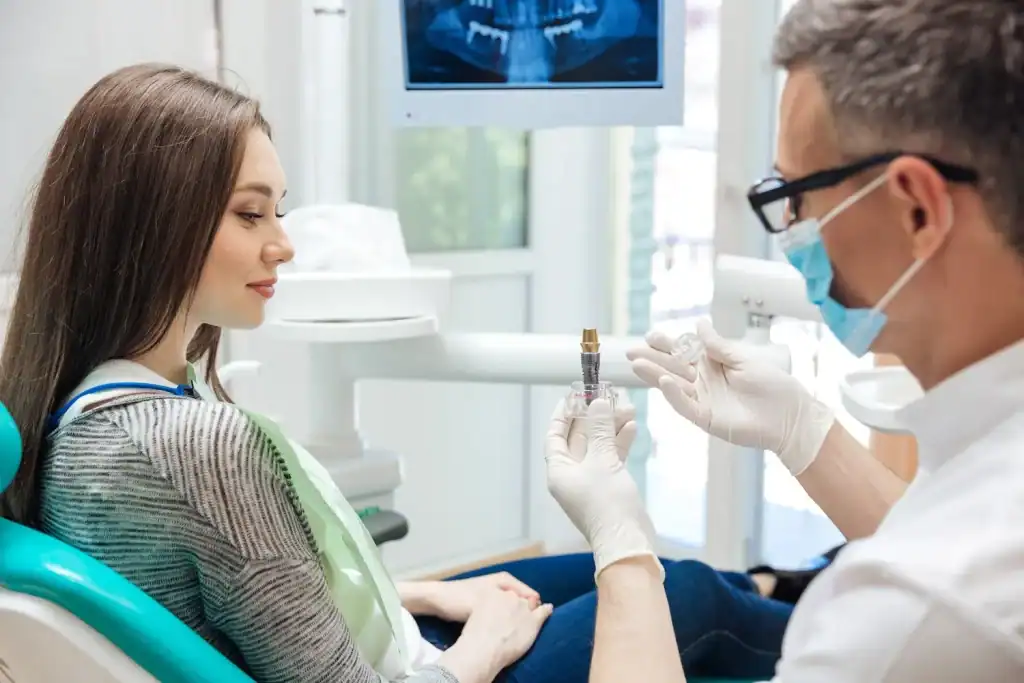
Losing most or all of the teeth in one jaw changes how you eat, speak and smile. The good news is that you have real choices. Full mouth dental implants can give patients in Des Moines and Lynnwood a stable, natural-feeling set of teeth again — whether that means four implants, six implants, or an implant-supported denture that clicks securely into place.
But “which option is best?” is the wrong first question. The better question is: which option fits your bone, your bite and your budget? Those three things guide almost every full-arch decision. This guide walks through each one in plain language, so you arrive at your consultation already knowing what to ask.
Full Mouth Dental Implants at a Glance
Three designs cover almost every full-arch case. Here is how they compare before we get into the details.
| Option | Implants per arch | Fixed or removable | Often the best fit when |
|---|---|---|---|
| All-on-4 | 4 | Fixed — never comes out | Bone is limited at the back of the jaw and you want teeth that stay in |
| All-on-6 | 6 | Fixed — never comes out | Your scan shows healthy bone volume and you want force spread more widely |
| Snap-on denture | 2–4 | Removable — you take it out to clean | You want a big jump in stability at a friendlier price point |
What “Rebuilding a Full Arch” Actually Means
An arch is one full row of teeth — your upper jaw is one arch, your lower jaw is another. Rebuilding a full arch means replacing all the teeth in that row at once, instead of one tooth at a time.
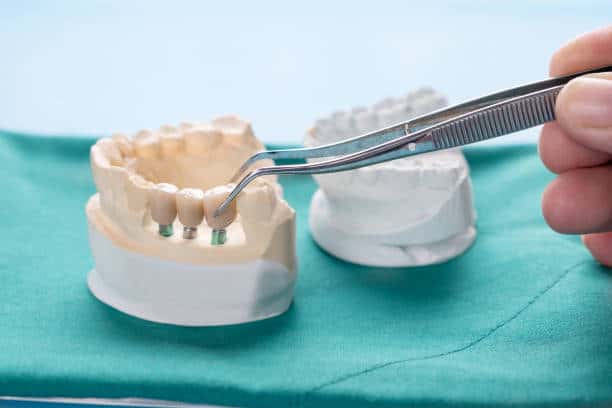
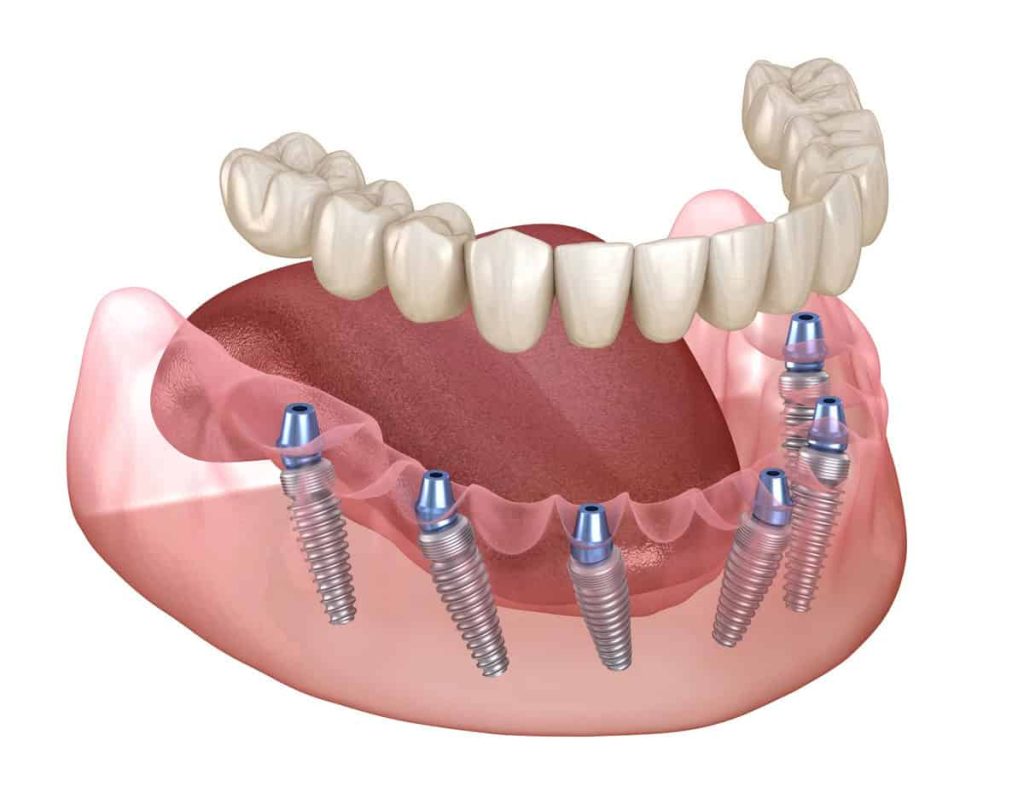
With full arch dental implants, a small number of titanium posts are placed in the jawbone. Those posts act like tooth roots and hold a full set of teeth in place. Depending on your needs, that new set of teeth can be fixed (it stays in permanently) or removable (you take it out to clean). The American Dental Association describes implants as artificial roots that provide a permanent base for replacement teeth, and that is exactly the job they do here — just repeated across a whole jaw.
You will hear a lot of names for these treatments: all on 4 dental implants, All-on-6, implant-supported dentures, implant retained dentures, snap-on dentures and “permanent dentures.” They overlap, and the differences mostly come down to how many implants are used and whether the teeth are fixed or removable.
Your Bone: How Much You Have Shapes Your Options
Implants need enough healthy jawbone to anchor into. When teeth have been missing for a long time, the bone that used to support them slowly shrinks. How much bone you have left is often the single biggest factor in which treatment fits.
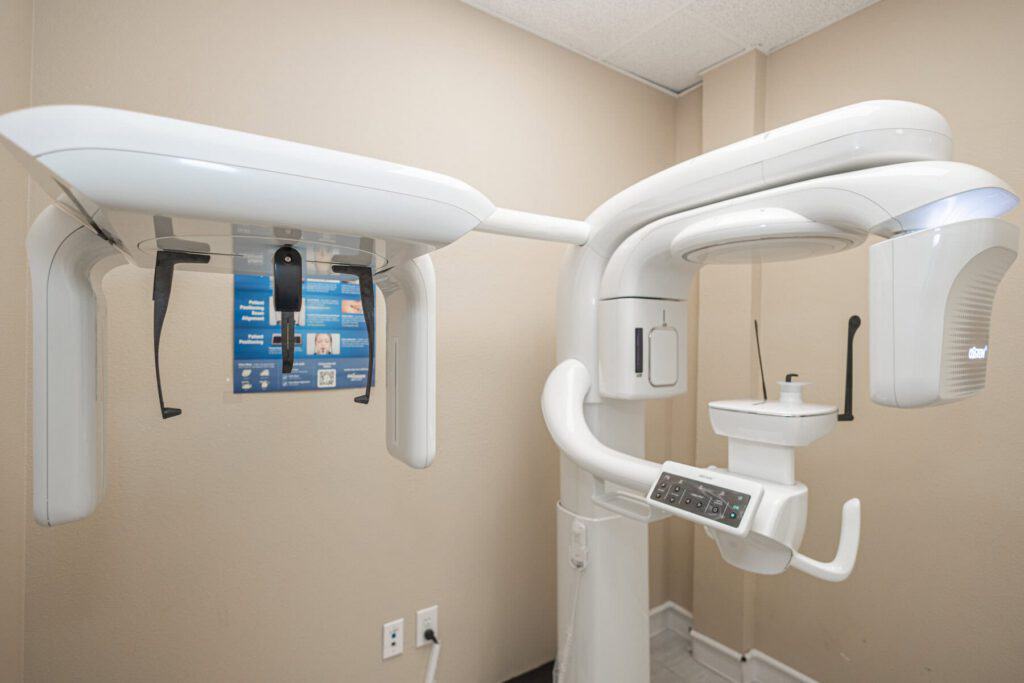
Why the First Step Is a 3D Scan, Not a Guess
A cone-beam CT scan shows the exact height, width and quality of your bone, plus where the nerves and sinuses sit. Both of our offices scan in-house, so the plan is built on your anatomy rather than an estimate:
- Plenty of healthy bone: You may be a candidate for more implants per arch, such as All-on-6 or another fixed full-arch design, which spread out chewing forces.
- Some bone loss: All-on-4 dental implants are designed for exactly this situation. The back implants are placed at an angle to use the denser bone you still have, which often avoids the need for bone grafting.
- Significant bone loss: You may still have good options. Grafting, ridge augmentation or platelet-rich fibrin can rebuild a foundation first — procedures we perform in our own oral surgery suite.
Angled placement and careful planning are a big reason many patients who were once told they did not have enough bone for implants turn out to be candidates after all. If failing teeth still need to come out first, that is planned as part of the same treatment sequence rather than a separate detour — see our page on tooth extractions.
Your Bite: Fixed Teeth or Removable Teeth?
The next question is how you want your new teeth to feel and work day to day. Broadly, there are two paths.
Fixed Full-Arch Implants (All-on-4 and All-on-6)
These teeth attach to your implants and stay in your mouth. You brush them, you do not take them out, and they feel closest to natural teeth. All-on-4 uses four implants per arch; All-on-6 uses six. Both are often called permanent dentures because the teeth are fixed in place. We place both designs, so the recommendation comes from your scan rather than from what happens to be on offer.
Implant-Supported and Implant-Retained Dentures

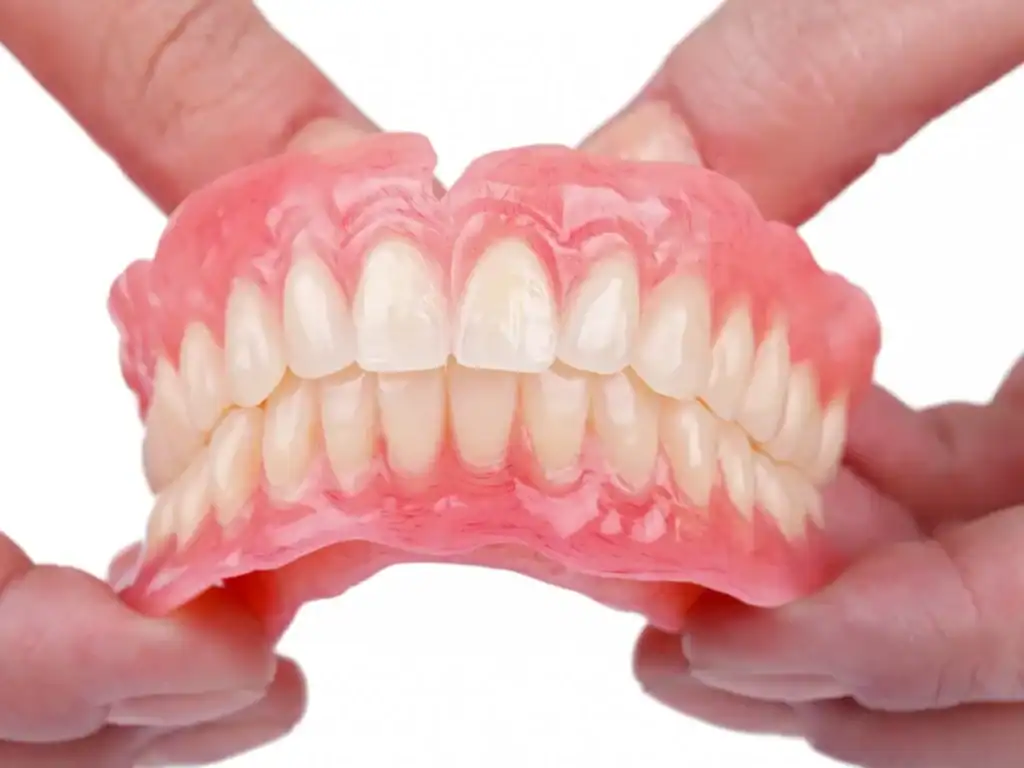
These are removable. Instead of resting on your gums with adhesive, the denture clips onto locator attachments fitted to two to four implants, and lifts off for cleaning. Many patients call these snap-on dentures. An implant-supported denture takes much of its support from the implants, while an implant retained denture mainly snaps on for stability and still rests partly on the gums. They cost less than a fixed arch and are far more secure than a conventional denture, but they do not feel quite as much like natural teeth.
A simple way to think about it: fixed options feel the most like real teeth, while removable options are gentler on the budget and simpler to clean.
Your Budget: What Really Drives the Cost of Full Mouth Dental Implants
Cost is on everyone’s mind, and it is a fair question. As a national reference range — not a quote — fixed full-arch implants typically run about $15,000 to $30,000 or more per arch, while implant-supported snap-on dentures generally fall between about $6,000 and $15,000 per arch. In the Puget Sound area, quotes often land in the middle to upper part of those ranges. A few things move the number the most:
- How many implants you need — two to four for a snap-on denture, four to six for a fixed arch.
- The material of your new teeth — acrylic hybrids cost less than solid zirconia.
- Extra steps such as extractions, bone grafting or sedation.
- Fixed versus removable — a removable implant denture usually costs less than a fixed arch.
- One arch or both — treating the upper and lower jaws together changes the total.
Patients often ask about full mouth dental implants cost with insurance versus without insurance. Most dental plans do not cover the whole treatment, but many contribute to parts of it, such as extractions, the diagnostic scan, or a portion of the denture. We accept Delta Dental and UHC directly, file as an out-of-network provider with other carriers, and verify your benefits at no charge before treatment. For the full picture on numbers and monthly payments, see our guide to dental implant costs in Washington and our financing and insurance options, which include CareCredit, Cherry, LendingClub and HFD.
Why the Cheapest Quote Is Rarely the Cheapest Treatment
Searches like “cheapest place to get all-on-4 dental implants” are understandable, but advertised starting prices and all-in prices are rarely the same number. A low headline figure often excludes extractions, the temporary arch, the final restoration or the imaging. Ask every practice for a written, itemized estimate covering the whole treatment from scan to final teeth, then compare those totals. That is the only comparison that means anything.
Putting Bone, Bite and Budget Together
Three patterns come up again and again in our consultations:
- A long-time denture wearer whose lower denture will not stay put. There is usually still enough bone at the front of the lower jaw for two implants, and a snap-on conversion is often the smallest change that solves the biggest daily problem.
- Someone with failing teeth who wants to skip the denture stage entirely. Fixed All-on-4 is designed for this: extractions, implants and a fixed temporary arch are usually completed in one surgical visit.
- A patient with good bone who wants maximum longevity. All-on-6 shares biting force across more implants and stimulates more of the jaw, and it is often the stronger long-term choice when the scan supports it.
When decay, wear and old dental work have damaged both arches rather than just one, the plan may go beyond implants alone into a staged full mouth reconstruction.
Why a Prosthodontist Plans These Cases Differently
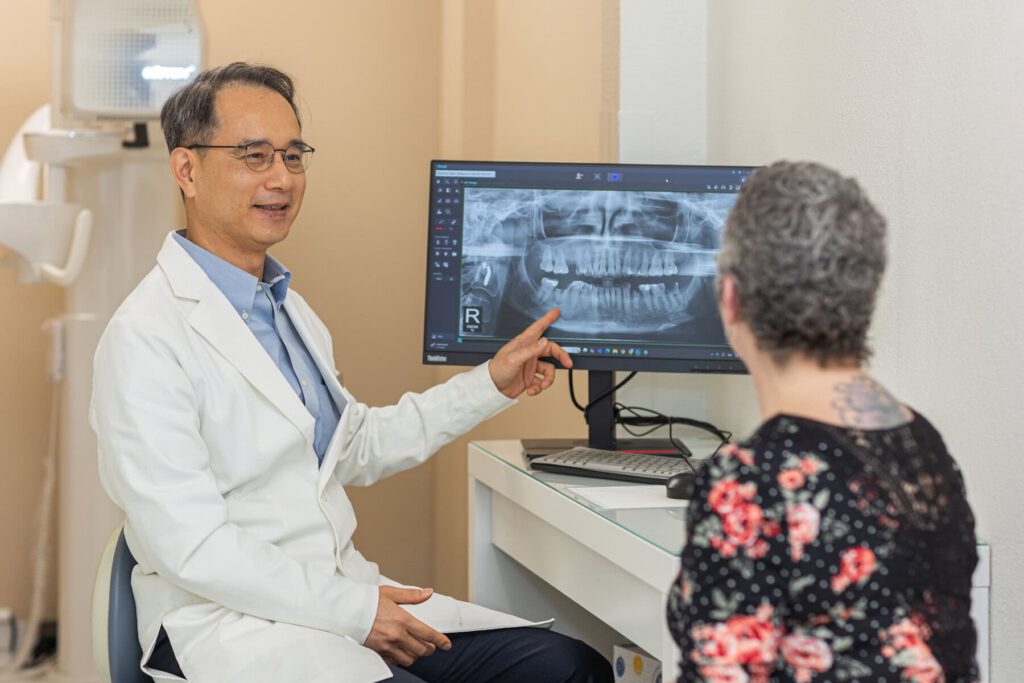
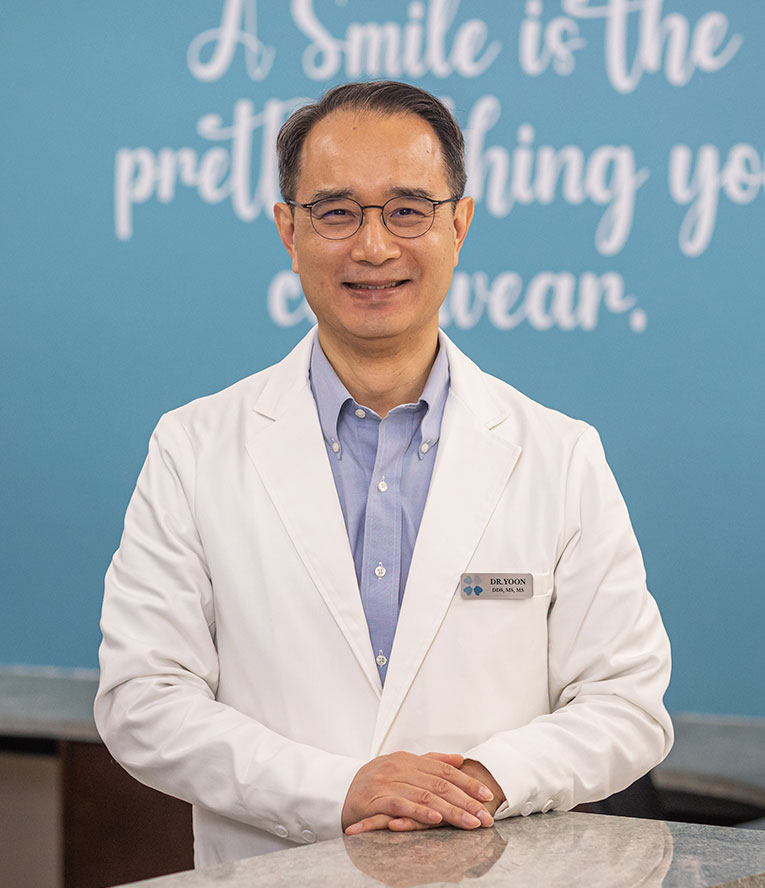
Full-arch treatment is as much about design as surgery. A prosthodontist is a dentist who has completed three additional years of specialty training in replacing teeth and rebuilding bites. At Blooming Dental, treatment is led by Dr. Sung Wook Yoon, DDS, MS — a Columbia-trained prosthodontist and former Harvard School of Dental Medicine clinical instructor with more than 5,000 implants placed over 30-plus years, and a second specialty residency in orthodontics behind him.
That planning matters. Using 3D-guided surgery and careful bite design, most patients leave surgery the same day with a fixed temporary arch, so you are not without teeth while your implants heal. The goal is not just teeth that look good on day one — it is a bite that stays comfortable and healthy for years. You can see examples of finished full-arch and reconstruction cases in our smile gallery, and read more about how a prosthodontist plans dental implants from the restoration backwards.
Living With and Cleaning Your New Teeth
A common question is how to clean all on 4 dental implants. Fixed arches are brushed like natural teeth, with a water flosser and a special floss threaded under the bridge once a day to keep the gum tissue healthy. Removable implant dentures are simpler still — you unclip them, brush them, rinse and clip them back in. The American Dental Association notes that removable prosthetics should be cleaned daily with a soft brush and a non-abrasive cleanser, and kept moist when they are out of your mouth.
What about the problems with all-on-4 dental implants? The most common issues are minor: gum irritation if cleaning slips, or a temporary tooth that needs adjusting before the final set is fitted. On snap-on dentures, the nylon inserts that create the click wear down and are refreshed in minutes at a routine visit. Serious complications are uncommon when the case is planned well and you keep up with checkups, which is exactly what those checkups are for.
Frequently Asked Questions
What is All-on-4?
All-on-4 is a full set of fixed teeth supported by four dental implants in one arch. The back implants are angled to use your available bone, which often avoids grafting and can allow a same-day temporary set of teeth.
What are permanent dentures?
Permanent dentures is an everyday term for a fixed set of teeth attached to implants, which includes All-on-4 and All-on-6. Unlike traditional dentures, they are not removed at night and are cleaned in the mouth like natural teeth.
How much do full mouth dental implants cost?
As a national reference range, fixed full-arch implants typically run about $15,000 to $30,000 or more per arch, and implant-supported snap-on dentures about $6,000 to $15,000 per arch. Your number depends on the implant count, the materials and any extra steps such as extractions or grafting. We provide a written estimate at your consultation.
Does insurance cover full mouth dental implants?
Most plans do not cover the entire treatment, but many contribute to parts of it, such as extractions, the diagnostic scan or a portion of the denture. We accept Delta Dental and UHC, file as an out-of-network provider with other carriers, and verify your benefits at no charge before treatment starts.
How do you clean All-on-4 dental implants?
Brush them twice a day like natural teeth, then clean underneath the bridge once a day with a water flosser and a threader floss designed for implant bridges. A hygienist removes the arch for a deeper clean at your regular maintenance visits.
What are the problems with All-on-4 dental implants?
The most common issues are minor and manageable: gum irritation when cleaning under the bridge slips, a temporary arch that needs adjusting, or normal wear on the prosthetic teeth over many years. Serious complications are uncommon in well-planned cases with regular maintenance.
Am I too old, or do I have too little bone, for implants?
Age itself is rarely the deciding factor, and many patients told they lack bone are still candidates thanks to angled implants and modern planning. A 3D scan is the only way to know for certain.
How long do full arch dental implants last?
The implants themselves are designed to last for decades when the surrounding bone and gum tissue stay healthy. The teeth attached to them are a wearing part, so the prosthetic arch may need repair or replacement over time, much as a natural tooth may need a new crown.
Ready to Find Your Best Option?
The right full-arch solution is the one that fits your bone, your bite and your budget — and the way to find it is a consultation with a prosthodontist and a 3D scan. You will leave with a clear, written plan, including what your insurance covers and what financing looks like per month.
Request an appointment at our Des Moines office or call (253) 201-2519, visit us in Lynnwood or call (253) 544-3429 — or start with the free 5-minute video consultation on our website. We welcome new patients from across South King County and Snohomish County.
This article is general information, not a diagnosis or treatment plan. Only an examination and a 3D scan can tell you which full-arch option is right for you.
Schedule a consultation and leave with a clear, personalized plan — including what insurance covers and what financing looks like.